
34-Inch to 38-Inch Handrail Height: Measuring Plumb from the Stair Slope
Adhering to a 34-inch to 38-inch handrail height when measuring plumb from the stair slope is a fundamental requirement for safety and regulatory compliance in modern construction. Whether you are working on a residential renovation or a commercial build, understanding how to apply these dimensions correctly ensures your project meets the necessary building standards.
This measurement is not merely a suggestion; it represents a critical safety threshold designed to provide stability for anyone navigating stairs. By learning the precise methods for calculating this distance, you can avoid costly rework and ensure that every handrail installation provides a secure, code-compliant grip for all users.
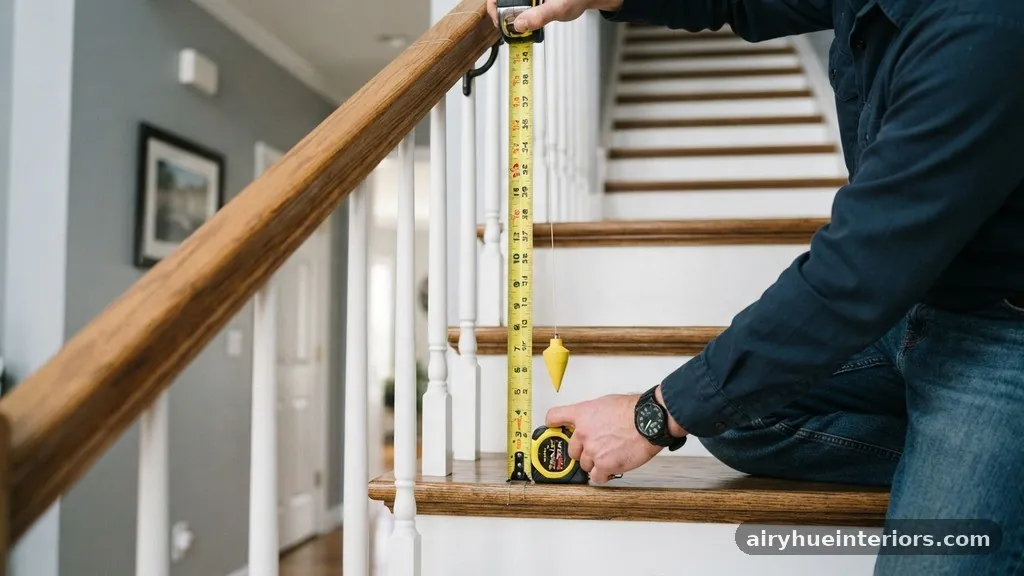
The specific requirement for a 34-inch to 38-inch handrail height means the vertical distance from the top of the stair nosing to the top of the gripping surface must fall within this range. When you measure plumb from the stair slope, you are essentially dropping a vertical line from the rail down to the front edge of the step.
If your measurement is below 34 inches, the rail is too low to offer effective support, whereas exceeding 38 inches places the rail out of reach for many users. Maintaining this specific vertical window is the primary way inspectors verify that a staircase is safe for public or private use.
Understanding the Measurement Method
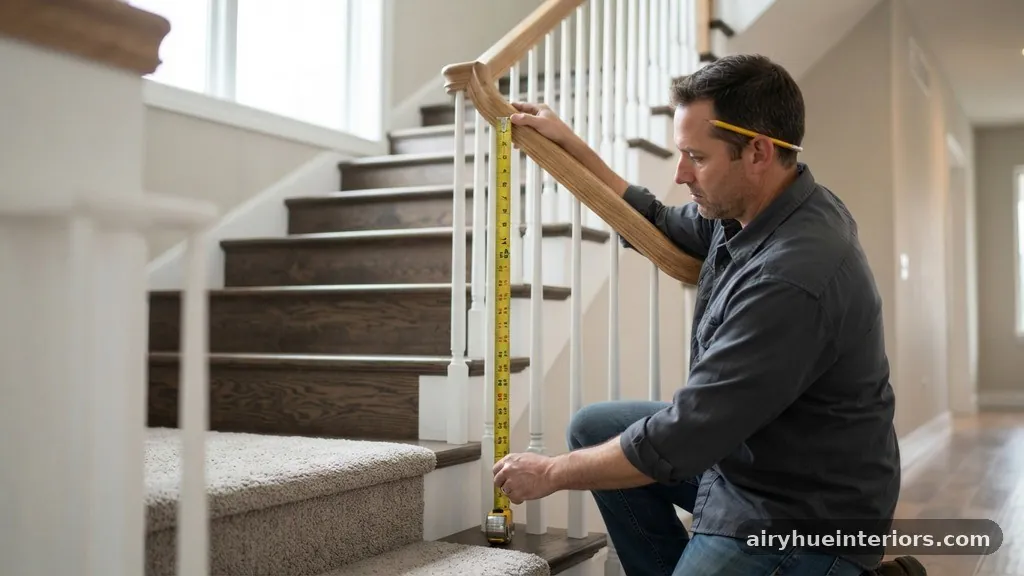
Measuring plumb from the stair slope is the only accepted way to verify compliance with international building codes. You must place your measuring tool, typically a tape measure or a laser level, directly against the front edge of the stair tread, also known as the nosing.
From this point, you extend the measurement vertically toward the ceiling, not perpendicular to the angle of the stairs. This vertical line ensures that you are capturing the exact height relative to the walking surface, which is how the code defines the safety boundary.
When you hold your tape measure, ensure it is perfectly vertical to achieve an accurate plumb reading. Even a slight tilt in your measurement tool can result in an error of half an inch or more, which could lead to a failed inspection.
Professionals often use a framing square or a dedicated stair gauge to keep the tape perfectly aligned with the vertical plane. If the staircase features decorative trim or molding at the nosing, ensure your measurement starts from the actual tread surface to maintain consistency across the entire flight of stairs.
The Role of International Residential Code
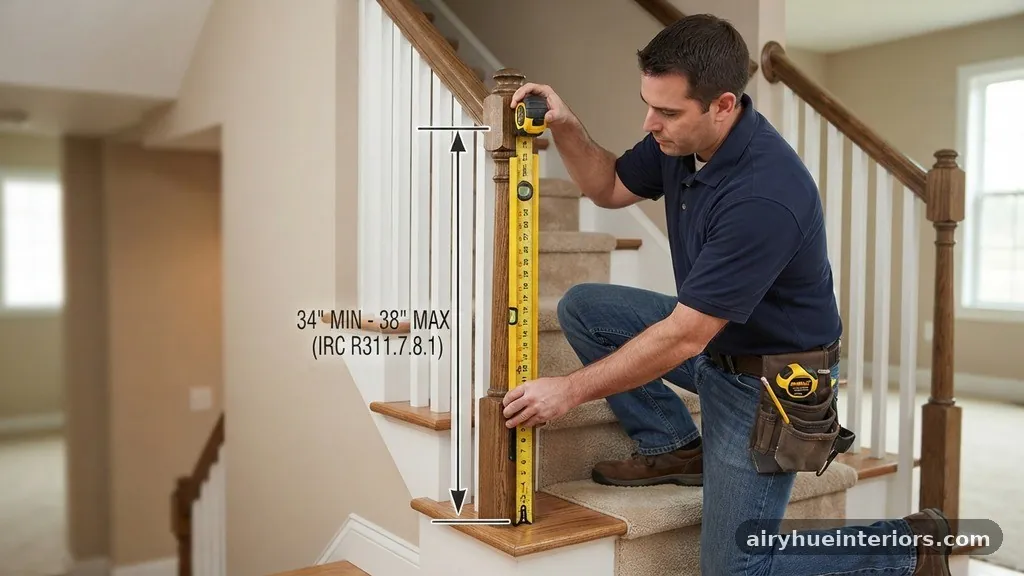
The International Residential Code, commonly known as the IRC, sets the standard for most home construction projects in the United States. Under these regulations, a 34-inch to 38-inch handrail height is mandatory for almost all interior and exterior residential stairways.
This code is designed to provide a uniform experience for users, regardless of the specific style or layout of the home. When you adhere to this range, you are aligning your work with the consensus of thousands of building professionals who prioritize occupant safety above all else.
The IRC also specifies that this height must be consistent throughout the entire length of the staircase. You cannot have a rail that starts at 34 inches and gradually climbs to 38 inches unless there is a specific design reason and the transition is gradual. Consistency is key because people rely on muscle memory when navigating stairs.
If the rail height fluctuates unexpectedly, it creates a tripping hazard rather than a safety feature. Always check your local amendments, as some jurisdictions might have stricter requirements than the base IRC.
Distinguishing Between Residential and Commercial Requirements
While the 34-inch to 38-inch handrail height is the gold standard for residential settings, commercial projects often face more stringent oversight. Commercial buildings frequently fall under the jurisdiction of the International Building Code (IBC) or the Americans with Disabilities Act (ADA), which may prioritize accessibility for individuals with mobility challenges.
In some commercial scenarios, the handrail height must be kept as close to the 34-inch to 38-inch range as possible to accommodate the widest variety of users. However, these settings often require additional features like specific extensions at the top and bottom of the run.
The following table highlights the common differences in application for various staircase types:
| Category | Standard Height Range | Primary Regulatory Focus |
|---|---|---|
| Residential Interior | 34″ to 38″ | IRC Compliance |
| Residential Exterior | 34″ to 38″ | Safety and IRC |
| Commercial Stairway | 34″ to 38″ | IBC and ADA Accessibility |
| Industrial/OSHA | 30″ to 38″ | OSHA Safety Standards |
Why Plumb Measurement Matters
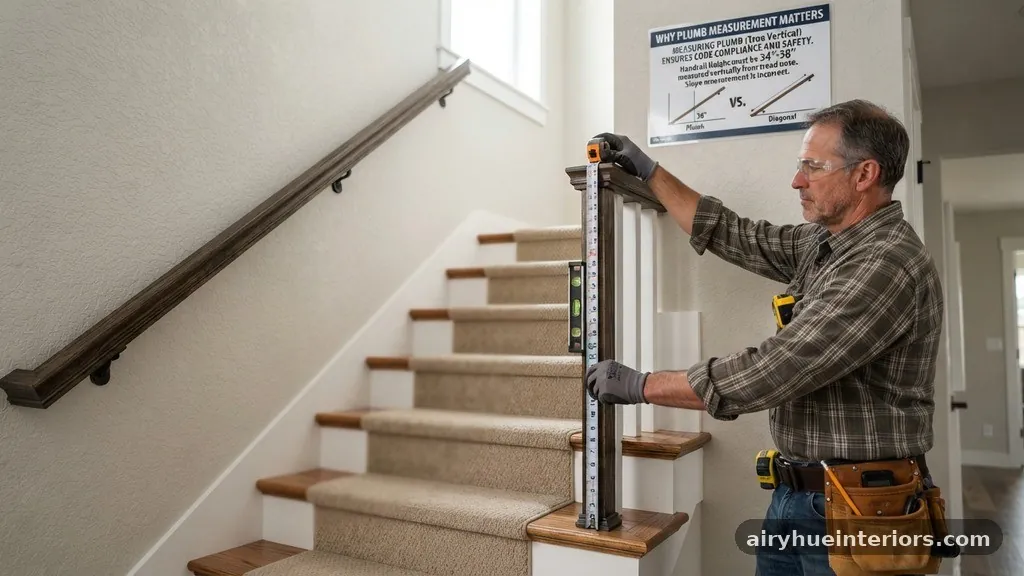
Measuring plumb from the stair slope is essential because it accounts for the actual distance a person’s hand travels while gripping the rail. If you were to measure perpendicular to the slope, you would get a shorter distance that does not reflect the reality of how the hand interacts with the rail.
A plumb measurement provides a true vertical reference point, which is the standard used by building officials during their final inspections. Without this standardized approach, every builder might measure differently, leading to inconsistent safety levels across the industry.
This measurement also accounts for the depth of the stair tread. Because stairs have varying tread depths, the angle of the slope changes, which would make a perpendicular measurement highly unreliable. By always measuring plumb, you eliminate the variable of the stair angle entirely.
This simplifies the process for the builder and ensures that the final product is predictable and safe for the end user. It is a classic example of a simple engineering rule that yields significant safety dividends.
Common Installation Mistakes to Avoid
Many installers make the mistake of measuring from the floor at the bottom of the stairs rather than from the nosing of each tread. This error often leads to rails that are too low at the bottom and too high at the top of the flight.
You must measure from the nosing of every single step to ensure the rail follows the correct slope. If you fail to account for the tread-to-tread variation, you will find yourself with an uneven handrail that fails to meet code requirements.
Another frequent error involves forgetting to factor in the thickness of the handrail itself. The 34-inch to 38-inch rule applies to the top of the gripping surface, not the bottom of the bracket or the mounting hardware.
If you mount a thick, decorative handrail, you must ensure the total height from the nosing to the top surface of that rail stays within the permitted range. Failing to account for material thickness is a common reason for failed inspections in custom railing projects.
Safety Benefits of Correct Handrail Positioning
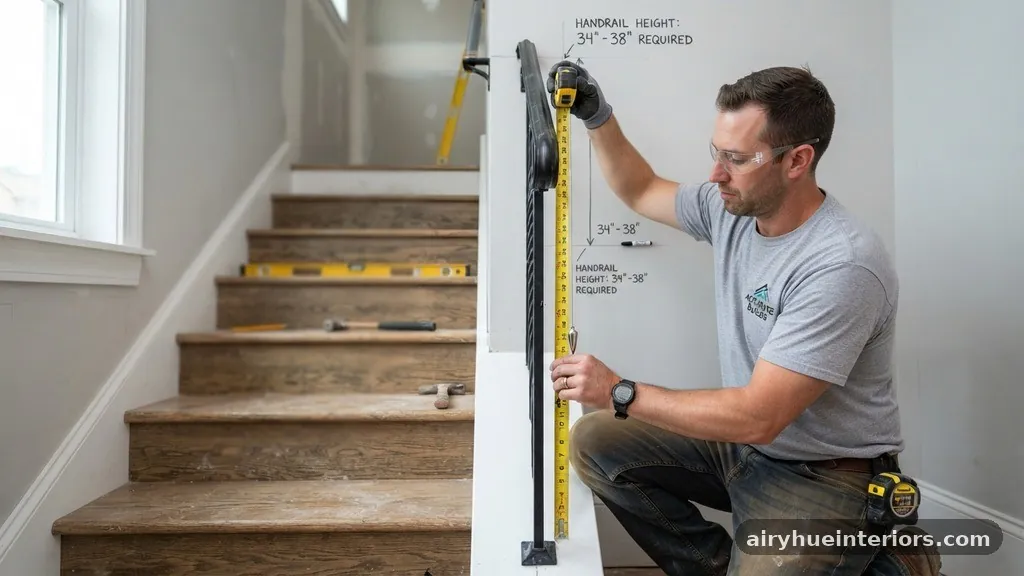
A properly positioned handrail acts as a secondary support system that prevents falls before they happen. When a rail is positioned within the 34-inch to 38-inch range, it aligns with the natural center of gravity for the average adult.
This allows the user to exert downward pressure on the rail without having to bend over or overextend their arm. If the rail is too high, the user cannot easily reach it in an emergency; if it is too low, it does not provide adequate support during a stumble.
Correct placement also encourages users to actually hold onto the rail. People are far more likely to use a handrail that feels comfortable and secure under their hand.
If the height feels awkward, users will often bypass the rail entirely, which increases the likelihood of accidents. By strictly adhering to the 34-inch to 38-inch height, you are creating an environment where safety is the natural and most convenient choice for everyone who uses the stairs.
Tools for Precision Measurement
Achieving a perfect 34-inch to 38-inch handrail height requires the right set of tools. A high-quality laser level is often the most efficient way to project a plumb line across the entire staircase.
By setting the laser to project a vertical beam, you can mark the exact height on your posts or wall supports with ease. This reduces the need for constant manual checks and helps you maintain a consistent line throughout the installation process.
For smaller projects, a simple stair gauge or a sliding T-bevel can be incredibly effective. These tools allow you to transfer the slope of the stairs to your rail sections, ensuring that your cuts and mounting points are perfectly aligned.
Always keep a reliable tape measure on hand to verify your marks before you drill any holes or commit to your final installation. Investing in quality measuring equipment is a small price to pay for the peace of mind that comes with a code-compliant staircase.
Adapting to Varying Staircase Designs
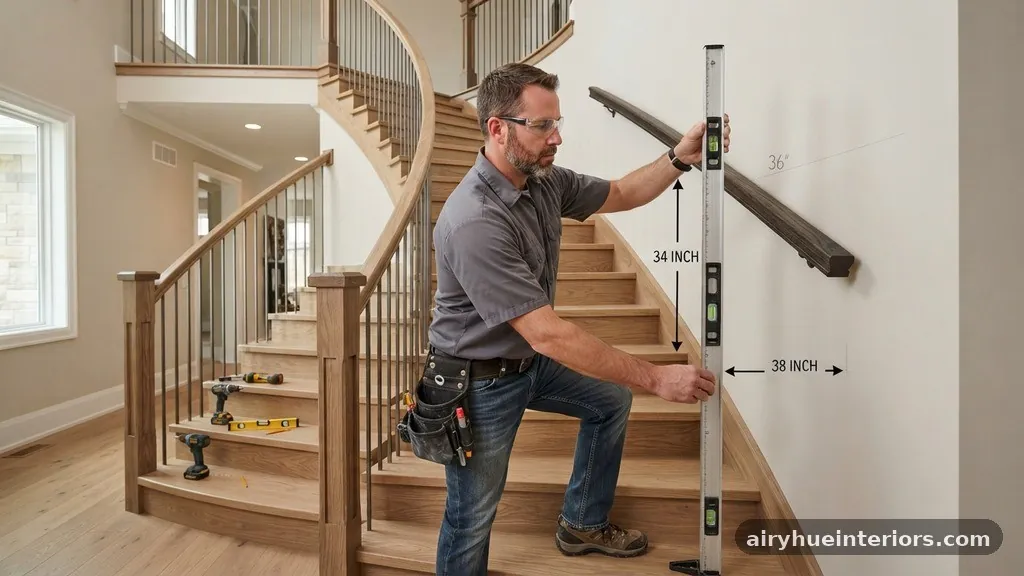
Not all staircases are straightforward, and unique designs often require creative solutions to maintain the required handrail height. For example, winding stairs or curved staircases present challenges because the slope changes constantly.
In these cases, you must focus on maintaining the plumb measurement at the point of the tread where the user is most likely to place their hand. This often requires additional support posts or custom-bent railing components to ensure the path of the hand remains within the 34-inch to 38-inch window.
If you are dealing with a staircase that includes a landing, remember that the handrail must continue to follow the slope of the stairs until it reaches the landing. At the landing, the rail height may need to transition to a standard guardrail height, which is often different from the stair rail height.
Always check the specific requirements for your local jurisdiction regarding transitions between stair rails and landing guards. Proper planning at the design phase will save you from having to rework your railing after it is already installed.
Key Considerations for Outdoor Installations
Outdoor stairs are exposed to the elements, which can cause materials to expand, contract, or shift over time. This makes it even more important to ensure your initial installation is rock-solid and well within the 34-inch to 38-inch handrail height range.
When working outdoors, consider the thickness of any decking material or decorative finishes that might be added later. These additions can raise the effective height of the stair, potentially pushing your handrail out of the compliant range.
* Ensure all mounting hardware is rated for exterior use to prevent rust or failure.
* Verify that your post-to-stair connections are strong enough to withstand heavy use.
* Account for seasonal ground movement that might shift the bottom stair or landing.
* Use materials that are resistant to weathering to maintain the integrity of the grip over time.
* Periodically check the tightness of mounting bolts, as vibration can loosen hardware over years of use.
FAQ Section
Does the 34-inch to 38-inch rule apply to every step on the staircase?
Yes, the height must remain consistent throughout the entire flight of stairs. You should measure from the nosing of each tread to ensure the handrail remains within this range at every point along the slope.
What happens if my handrail is slightly outside the 34-inch to 38-inch range?
In most cases, this will result in a failed building inspection. Inspectors use these measurements to ensure safety, and a variance of even an inch can be enough to require a complete reinstallation of the railing system.
Can I use a different height if the residents are exceptionally tall or short?
Building codes are written for the general public and typically do not allow for deviations based on individual height. You must adhere to the 34-inch to 38-inch range to ensure the staircase remains safe for everyone who might use it.
Is the measurement the same for both sides of a staircase?
The measurement requirements are the same regardless of which side of the stairs the rail is on. Both the left and right handrails must meet the same plumb measurement standards to ensure consistent safety for all users.
How do I measure for a handrail that turns a corner?
When a handrail turns a corner or reaches a landing, you must maintain a continuous gripping surface whenever possible. The transition must be smooth, and the vertical height should stay within the prescribed range throughout the entire path of the railing.
Final Thoughts on Railing Safety
Maintaining a 34-inch to 38-inch handrail height when measuring plumb from the stair slope is a vital practice for any builder or homeowner. This specific range is not just a regulatory hurdle; it is a proven standard that provides the best possible support for users navigating stairs.
By taking the time to measure correctly from the nosing of each tread, you ensure that your work is both safe and compliant. Consistency is the secret to a professional installation that stands the test of time and keeps occupants secure.
If you are currently planning a staircase project, take the time to map out your measurements before you begin construction. Verify your local building codes, gather the right tools, and double-check your plumb lines as you progress.
A well-installed handrail is a lasting investment in the safety of your home or business. Should you have questions about your specific layout or material choices, don’t hesitate to consult with a local building official or a licensed contractor to ensure your project meets all requirements.